Cheap Wine Shelf vs Expensive Wine Shelf. Let’s Talk About Real Pros and Cons
 If you ended up on this page, you’re probably asking yourself one simple question: why do some wine bottle shelves cost $30–50, others $70–150, and some $200–500? And that’s not even the limit. Visually, the products in photos often look very similar, if not almost identical. The difference comes down to materials, details, and manufacturing methods.
Let’s take a practical look at why this price gap exists, and what real advantages and disadvantages each price category has.
- Wine shelves under $50
Pros:
The main advantage is obvious — the price. A $20–30 wine shelf is something most people can afford. Cheap, practical, and reasonably functional. Shelves closer to the $50 range may even have acceptable quality and not fall apart during use or assembly. Unfortunately, that’s where the advantages usually end.
Cons: It’s always easy to criticize someone else’s work, so instead we suggest simply reading customer reviews on Amazon, eBay, or similar platforms. They tend to be more honest than any arguments we could make.
Most wine shelves in this category use low-quality materials and components, are mass-produced, and often lack precision. You should be prepared to fix or adjust a $30 wine shelf yourself. There are exceptions, of course, but they are rare.
Solid wood is not part of the conversation here. At best, you’ll get glued wood panels, particle board, plywood, or something similar. In the $50 range, things vary — sometimes it’s still cheap wood, but technically real wood. For example, thin pine, usually in a small shelf designed for 2–3 bottles. The key is to carefully read the product description.


- Wine shelves in the $70–150 range
Pros:
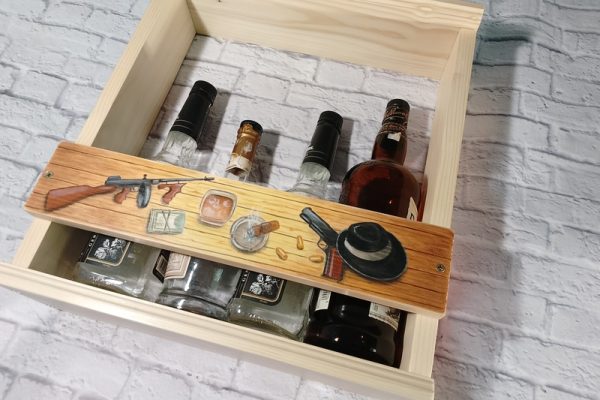
This is the most common price category for wine shelves. Pine is typically used as the main material, sometimes recycled from pine pallets. Oak can also appear here, especially recycled oak barrels from whiskey production.
 Overall quality is usually acceptable, and buyers are rarely disappointed. These shelves are often made by small businesses or medium-sized companies that specialize in wine storage for cellars, private bars, and similar spaces.
It’s important to understand that a small liquor shelf for $120 and a mini bar for $120 are completely different products in terms of build quality. To make a larger item for the same price, manufacturers must save somewhere — and where exactly they save depends on the producer.
Cons:
Despite the advantages, this segment has its downsides. The wood is often recycled — used pine pallets or oak barrels, as mentioned earlier. There’s nothing inherently wrong with that, but if brand-new lumber were used, the price would be 2–3 times higher.
 Glued wood is also very common. This is standard practice in modern furniture production, with adhesives and chemical treatments used everywhere. However, it’s not the same as solid wood furniture from your grandfather’s or great-grandfather’s time.
This is a reasonable compromise to keep wine shelf prices within the $100–150 range, but it doesn’t offer that “Good Old Days” solid wood feel. As with cheaper shelves, you can occasionally find solid wood shelves in this price range, but they are usually small and designed for 3–4 bottles. Always read the description carefully.
Wooden Wine Glass Coasters Made from Plum Wood, Rustic Wooden Wine Stands
Price range: 12.40 $ through 14.50 $Select options





- Wine shelves priced $200–500 and higher
Pros:
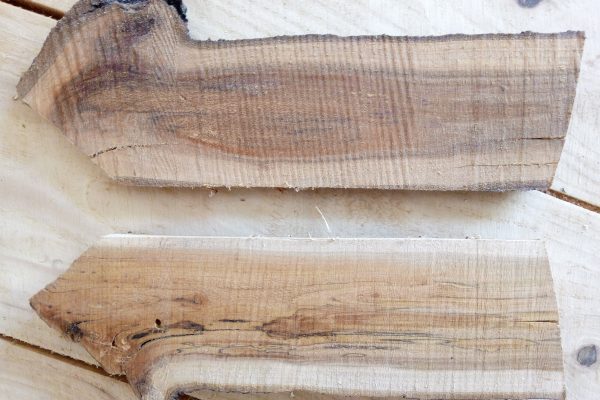
In this price range, wine shelves are very likely made from real solid wood. Sometimes glued panels (furniture boards), sometimes single longitudinal slabs. Wood species may be premium: walnut, oak, fruit woods, burl wood, spalted wood, red or black African hardwoods, or exotic species from Asia or Latin America.
 Even as raw lumber, these materials are expensive — not to mention finished woodworking pieces.
Wine shelves priced at $300–500 usually feature original, non-template designs. Some are even made to custom sketches. Visual appeal is noticeably higher than shelves in the $100–120 range. These products are typically made by small workshops specializing in alcohol storage or mid-to-upper-range home décor.
That said, price alone doesn’t guarantee quality. Every case is individual. A small shelf for $400–600 and a full wine cabinet for $700 are completely different products made from different materials. Always read product descriptions to understand what you’re actually paying for.
Cons:
Quality and exclusivity come at a price, and not everyone is comfortable with it. Solid wood shelves are also significantly heavier. Simply screwing them into drywall usually won’t work — strong walls or proper anchors for the specific wall material are required.
 Final thoughts
A $500 price tag is far from the upper limit. Solid wood wine storage can easily cost $1,500–2,500 or more. There’s no real ceiling in this category. However, for the mass market, most products fall into the three price groups described above — each with its own strengths and weaknesses. Which one to choose is entirely up to you.
While you’re here, feel free to explore our wine shelves. We offer various themes and designs, so everyone can find something that fits their taste. Our shelves are made from longitudinal wood slabs, suitable for wine, whiskey, tequila, and other spirits, and feature original designs. For this level of craftsmanship, we believe the pricing is quite reasonable. Browse, compare, and ask questions — we’re always happy to help.